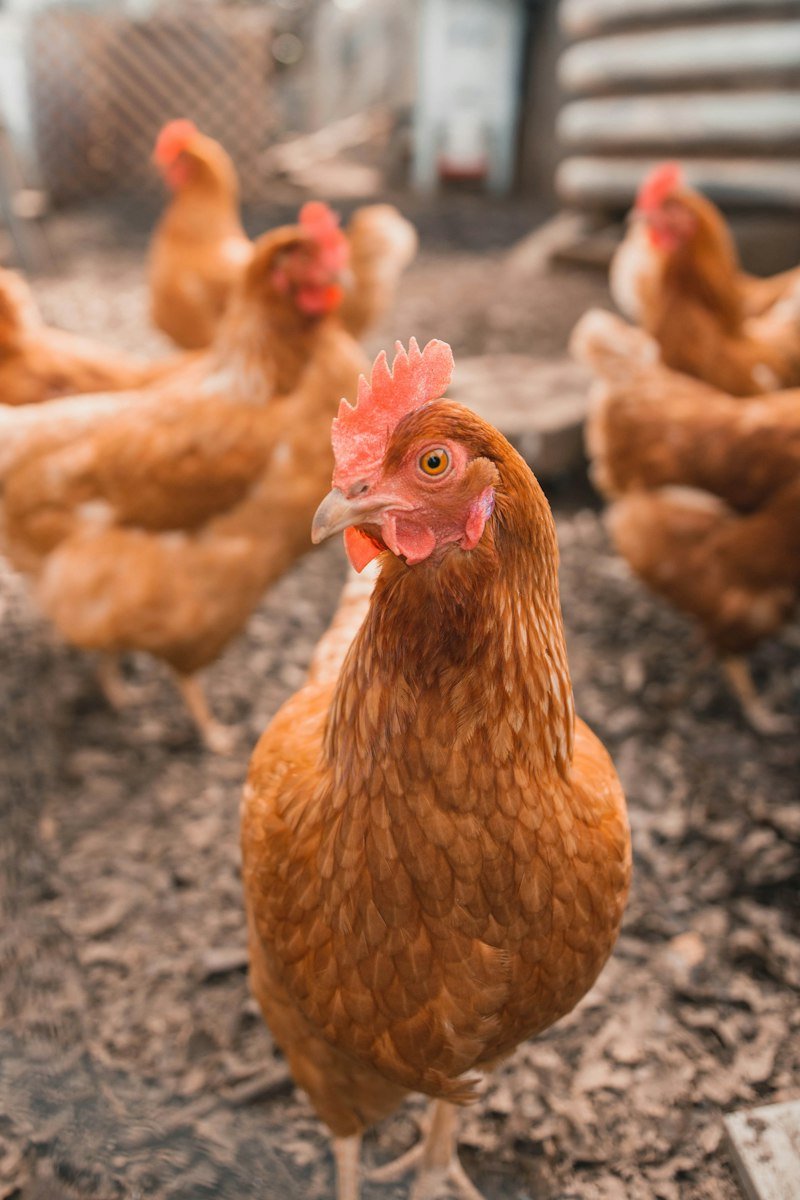
 Photo: woodley wonderworks / Wikimedia Commons · CC BY 2.0
A workable enclosed-range layout
Start with a predator-resistant night house connected to a secure service yard. Divide the outdoor area into at least three usable paddocks so birds can graze one while the others recover. More divisions give better control. Put gates where people can inspect fencing, move birds and bring equipment without crossing dirty and clean routes.
Dry litter, nests or perches, quarantine access, feed storage and a hard-standing area around drinkers.
Vegetated ground, shade or shelters, dust-bathing material and distributed resources.
Plants regrow, damaged areas are repaired and manure nutrients are assessed before birds return.
The perimeter must suit local predators and the bird species. Poultry netting may need a buried apron, electric offset or overhead netting. Ducks need aggressive drainage around water. Quail require a fully covered enclosure. Turkeys need larger doors, stronger fittings and more headroom. Free-range access never removes the need for a safe house.
What to grow in the range
Pasture is enrichment and a supplementary source of forage—not a substitute for a balanced poultry ration. Select plants that are locally adapted, non-toxic, persistent under traffic and compatible with the farm's rainfall, soil and irrigation. A local extension agronomist should confirm the mix.
| Function | Temperate examples | Warm-region examples | Management note |
|---|---|---|---|
| Durable ground cover | Perennial ryegrass, orchardgrass/cocksfoot, suitable fescues | Bermudagrass, bahiagrass, locally adapted pasture grasses | Choose non-endophyte or livestock-safe varieties where relevant; never assume a grass is safe from its common name alone. |
| Legume diversity | White clover, red clover, lucerne/alfalfa where suitable | Forage peanut and locally approved tropical forage legumes | Legumes can add nitrogen but do not eliminate the need for soil testing or nutrient control. |
| Broadleaf forage | Chicory, forage plantain | Locally approved chicory/plantain or other non-toxic broadleaf forage | Use a mixed sward; broadleaf plants are often less traffic-tolerant than grass. |
| Seasonal cover | Oats, rye, wheat, brassicas where locally suitable | Millet, sorghum-sudan types only when confirmed safe and correctly managed | Seasonal species fill feed gaps but may need reseeding and careful maturity management. |
| Shade and shelter | Established orchard trees or shelterbelts | Established, locally non-toxic shade trees and shrubs | Protect trunks and roots; do not give birds access to treated, toxic or freshly planted trees. |
How to care for the field
- Rotate before bare soil develops. Move birds when plants are heavily grazed, soil becomes wet or traffic concentrates—not after the paddock is destroyed.
- Keep a protective residual. A practical trigger is to avoid removing more than about half of available forage, then allow full recovery; actual height and rest period vary by species and season.
- Move pressure points. Relocate mobile shelters, shade, feeders and drinkers so droppings and scratching do not remain concentrated in one place.
- Protect wet ground. Shut paddocks during waterlogging. Use a roofed or surfaced loafing area rather than sacrificing the entire field.
- Repair promptly. Rake severe thatch, level holes, oversow bare patches, control weeds without exposing birds to unsafe products, and rest new seedlings until roots are established.
- Test soil. Track pH and especially phosphorus, potassium and nitrogen risk. Do not apply manure or fertiliser simply because vegetation looks thin.
What happens to the droppings?
Droppings deposited outdoors enter the soil nutrient cycle. In a well-managed, lightly stocked rotation they can contribute organic matter and plant nutrients. They do not disappear instantly, and they are not automatically harmless. Heavy deposits can burn vegetation, increase phosphorus, create ammonia and odour, attract flies, move pathogens, and pollute drains or surface water.
Collect house litter and manure from hard-standing areas. Compost only in a contained, drained site at safe separation from wells and watercourses, following local rules. Keep fresh poultry litter away from ready-to-eat crops. A nutrient-management plan should match all manure—including what birds deposit outside—to realistic crop uptake. If soil tests show accumulation, reduce stocking pressure, extend rest, harvest plant material, or move composted nutrients to land that actually needs them.
Daily care on range
- Count birds out and in; investigate missing, isolated, lame, dull or panting birds immediately.
- Provide complete feed and clean water every day. Range plants do not balance energy, amino acids, minerals and vitamins.
- Spread shelters and resources so timid birds can use them and so the flock does not crowd the house entrance.
- Inspect fence voltage or integrity, burrows, overhead predator risk and signs of dogs, foxes, snakes or raptors.
- Keep wild birds away from feed and water. Follow veterinary housing orders during avian-influenza or other disease events.
- Use dry dust-bathing areas for chickens and turkeys; manage duck water so birds can clean their heads without saturating the sleeping area.
- Record weather, paddock used, feed and water intake, eggs or weight, mortality, treatments and pasture condition.
A simple rotation decision
Do not rotate by calendar alone. Check vegetation cover, residual height, soil moisture, parasite and disease risk, manure concentration and forecast weather. A paddock returns to use only when the sward has recovered, damaged areas are stable and local biosecurity restrictions allow outdoor access.
Evidence and local verification
This guide uses planning principles from Penn State Extension's pastured-broiler guidance, its guidance on soil fertility and repeated manure application, and the UK government's poultry welfare information. Plant choice, stocking, outdoor access, manure storage, setbacks, food safety and disease controls must be checked with local agricultural, environmental and veterinary authorities.