The Economics of Commercial Crocodilian Husbandry
Commercial crocodile farming is one of the most profitable yet capital-intensive specialties in global agriculture. A single Grade-1 flawless belly skin commands hundreds of dollars from European luxury tanneries for fashioning Birkin bags, luxury footwear, and bespoke luggage. Secondary revenues include vacuum-packed tail fillets (a tender, low-fat white meat prized in export hospitality), crocodile oil for pharmaceutical skincare, and polished skulls and teeth for curio markets.
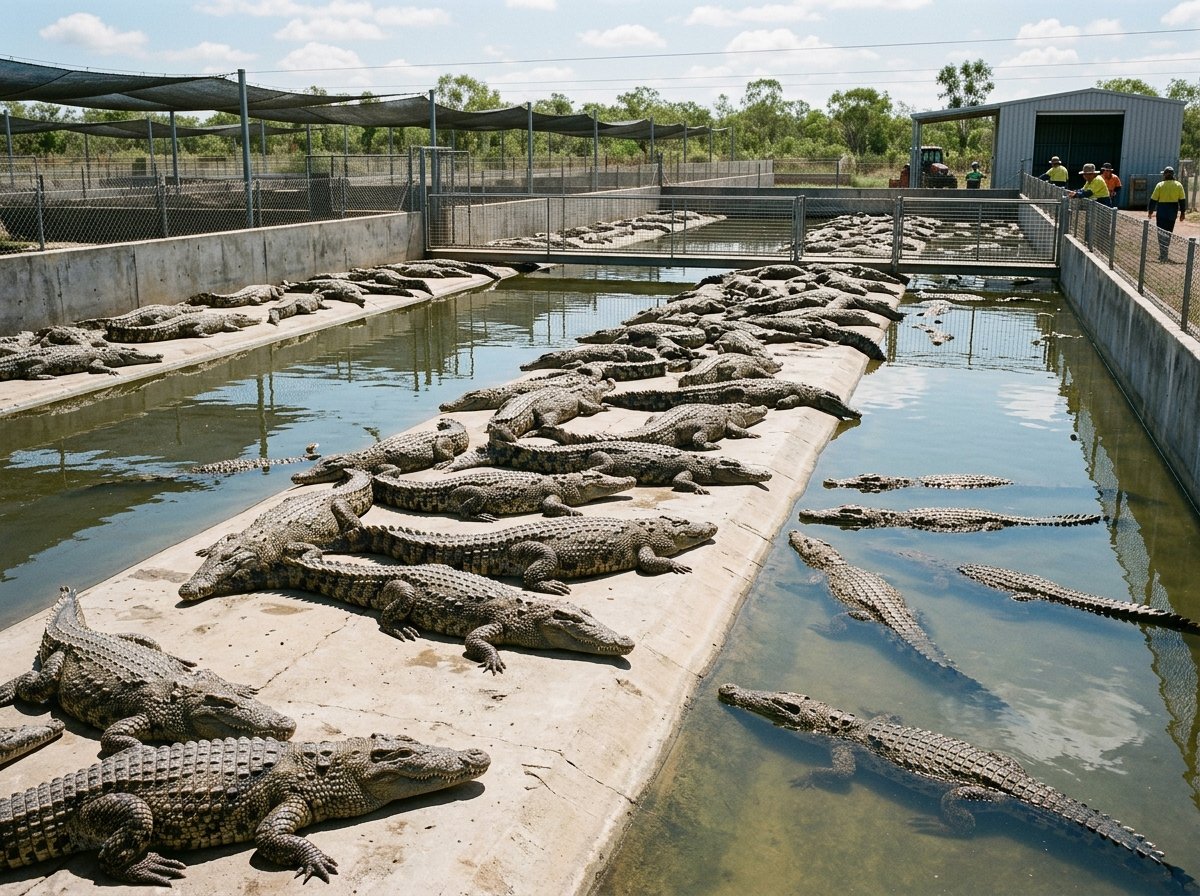
Pen Engineering & Scratch Prevention
Skin condition dictates 85% of farm revenue. A single scratch or scale abrasion drops a skin from Grade-1 ($450) to Grade-3 ($120). Modern grow-out architecture is built specifically to prevent physical defects:
- Smooth-Troweled Concrete Surfaces: Eliminates coarse gravel or abrasive aggregates. Concrete floors must have zero rough ridges.
- Water-to-Land Gradient: Maintain a 1:3 water-to-basking ratio. Water channels must have curved, smooth ramps to facilitate non-abrasive entry and exit.
- Unitized Finishing Pens: For the final 4 to 6 months before slaughter, animals are housed in single-occupant or low-density darkened finishing pens to prevent social biting, clawing, and fighting.
- Controlled Water Temperature: Water temperature must be maintained strictly at 31°C to 33°C using heat pumps, solar arrays, or biogas heating. Digestion halts below 26°C.
Nutrition & Growth Acceleration
Crocodiles are strict obligate carnivores with exceptional feed conversion ratios (FCR 1.2 to 1.6 on wet weight basis):
- Primary Rations: Minced whole chicken frames, day-old cockerels, chilled marine/freshwater trash fish, and boneless red meat trimmings.
- Ratite/Croc Premix: Must be supplemented with calcium carbonate, dicalcium phosphate, vitamin A, D3, E, and biotin to maintain thick, flexible belly scales.
- Feeding Schedule: 3 times weekly at 3% to 5% body weight during warm cycles, ensuring all food is cleared within 40 minutes to preserve tank hygiene.
CITES Appendix II, Tagging & Export Compliance
All commercial international crocodilian trade is strictly governed by the Convention on International Trade in Endangered Species of Wild Fauna and Flora (CITES):
- Closed-Cycle Captive Breeding Certification: The operation must be registered with the national wildlife conservation authority as an authorized captive breeding facility.
- Tamper-Proof Serialized Tags: Every skin must have an official non-reusable plastic or metal locking CITES tag inserted through the caudal scute before export.
- Veterinary Sanitary Clearance: Meat and hides require veterinary certificates affirming absence of salmonella, anthrax, and spirochetes.